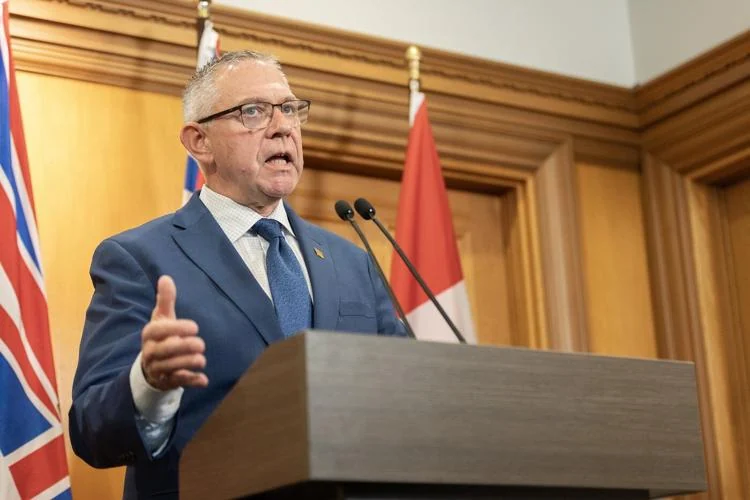
Victoria ( with files from Wolfgang Depner The Canadian Press) – British Columbia Premier Lorne Doerkson has announced plans to build a bridge to replace the Massey Tunnel, scrub a gender teaching program in public schools and bring public servants back to the office just five days into his job.
Doerkson made the announcements after his first cabinet meeting on Wednesday, saying “there certainly is a need to spend better in this province.”
The premier campaigned on scrapping the tunnel project that is currently under construction and replacing it with a bridge.
While Wednesday’s announcement was not the “final decision,” government will post a “notice of intent for design of a bridge option,” he said.
“I’m not interested in losing any more time, than we have to,” he said.
Doerkson said he is also directing Education Minister Lynne Block to remove Sexual Orientation and Gender Identity resources from government websites and schools, while strengthening other anti-bullying resources.
“SOGI 123 has become a lightning rod for division in this province, but our schools should be places to bring children together,” he said.
Parents are essential partners in their children’s education, Doerkson said.
“They are the ones raising their children, and we believe they should have a say in how and when sensitive topics are introduced,” he said.
Carole Gordon, president of the BC Teachers’ Federation, said in a news release that they are “disappointed” over the removal of SOGI 123 resources from government sites and schools, saying the decision is “rooted in misinformation.”
Gordon said this government is taking British Columbians in the wrong direction.
“We also have questions about what this means in practice,” said Gordon, “Which resources does the government intend to remove? Those labelled SOGI 123? Books that reflect the diversity of our families? How far backward is this government trying to take us?”
Gordon said she wanted to offer reassurance to LGBTQ+ students, parents, colleagues, and families, saying their rights will be protected by the BC Human Rights Code.
Tri-Cities Green Candidate and Trans Activist Nicola E Spurling posted to Facebook: There you have it. The BC Conservatives did about all they have the power to do, and SOGI continues to exist. Since SOGI isn’t legislation that can be repealed, the BC Conservatives have opted to just remove government references to it. Teachers can still access the SOGI website and download whatever resources they want, so this changes very little. Hopefully the bigots will see this as a win and the government can move on to doing things that are actually productive.
Kim Henderson, the newly appointed head of the public service, will start to implement the return of government workers to their offices, Doerkson said.
The process will unfold over phases.
“Of course, nobody is going to be told to be back at the desk by Monday,” he said. “That’s why the plan is to be phased, and it’s why Kim has the room to sequence it properly. She knows how this organization runs far better than I do, and I trust her to get this right.”
Henderson is a former deputy to the premier to previous Liberal governments.
Paul Finch, president of the British Columbia General Employees’ Union, said it is “incredibly disappointing” that the government would announce the back to work plan without consultation.
“We’ve reached out to bring forward the concerns of civil servants and have not received a response,” said Finch on social media.
Facebook statement from BCGEU: Premier Doerksen announced that he has asked the head of the public service to begin a return to office process for the public service. We’re frustrated that the government made this decision without consulting the BCGEU. Today, we sent another letter to the Premier, asking that he pause any changes to in-office requirements until our union meets with his government.We know that a blanket return to office mandate will increase government costs, undermine affordability for thousands of workers and hollow out rural and suburban communities that have benefitted from remote and hybrid workers.Our union will continue to push back against a blanket return-to-office mandate. We’ll keep pressing the government for a meeting and making our case in the media. We’ll keep you informed as we learn more about the government’s plans and what our union is doing to protect your interests
Doerkson’s announcements came after mandate letters were issues to his new cabinet ministers.
While the directions set out in letters largely restate election promises, they also flesh out priorities of the new government.
Ministers have been told to reduce the number of civil servants, cut climate change initiatives and set out a plan to pay for private health treatments if wait times are surpassed.
Health Minister Ryan Peterson is tasked with introducing a universal health-care guarantee and fulfilling the promise to provide medical care through “another qualified provider” when medically recommended wait times are exceeded.
Conservatives first raised the idea in their platform, but neither the platform nor the mandate letters spell out what is meant by “another qualified provider.”
Peterson’s mandate letter repeats election promises for a rural health emergency fund of $50 million and flexible staffing to keep rural emergency rooms and maternity wards open.
The new minister is also asked to launch a 100-day health care review to identify reforms from other universal public system that cut “waits, expand capacity, keep ERs open, and strengthen rural services, without user fees.”
The job for Finance Minister Peter Milobar is to chop government staffing, while protecting front-line workers.
Conservatives said in their election platform that staffing in ministries and special offices had increased by almost 38 per cent since 2016-2017, while B.C.’s population had grown by 19.6 per cent since 2015-2016.
Doerkson said they hope to whittle down the public service largely through attrition.
“We are certainly not in a position to expand on a public service that has grown by 30 per cent, nearly, in the last number of years and we do want to get back to a place where that public service grows in connection to population growth.”
Milobar, who was the Conservative finance critic while the party was in Opposition, is also asked to “immediately appoint” an independent panel to review the province’s “true fiscal position” and report the findings publicly.
The most recent figures forecast a deficit of $13.8 billion left by the former NDP government.
Doerkson has asked in the letter that Milobar chart a “realistic return to fiscal balance over time,” with “spending benchmarks and guardrails as the economy grows.”
Other key elements of Milobar’s mandate cover taxes and personal finances.
They include raising the basic personal amount to $32,000, up from $13,216, as part of a tax relief program that would amount to about $1,000 per person.
Milobar’s mandate repeats the Conservative platform’s language around auto insurance.
He is asked to keep “auto insurance affordable by maintaining ICBC as a public option” and preserve no-fault insurance for the “vast majority of claims.”
Catastrophically injured victims are to receive access to legal representation, “with capped legal fees,” so the cost of lawyers doesn’t drive up premiums or reduce compensation for victims, the letter says.
Environment Minister (Chilliwack-Cultus Lake MLA) A’a:liya Warbus has been asked to end the sales quota for zero-emission vehicles, along with regulatory changes that include the repeal of Clean BC, the former NDP government’s program aimed at lowering emissions that drive climate change.
Doerkson said Clean BC costs around $700 million a year and he’s “just not certain what it’s achieving.”
“So, we are going to move in a different direction there for sure. It’s one of the places that we’re convinced we can save hundreds of millions of dollars.”
This report by The Canadian Press was first published Nov. 25, 2026.