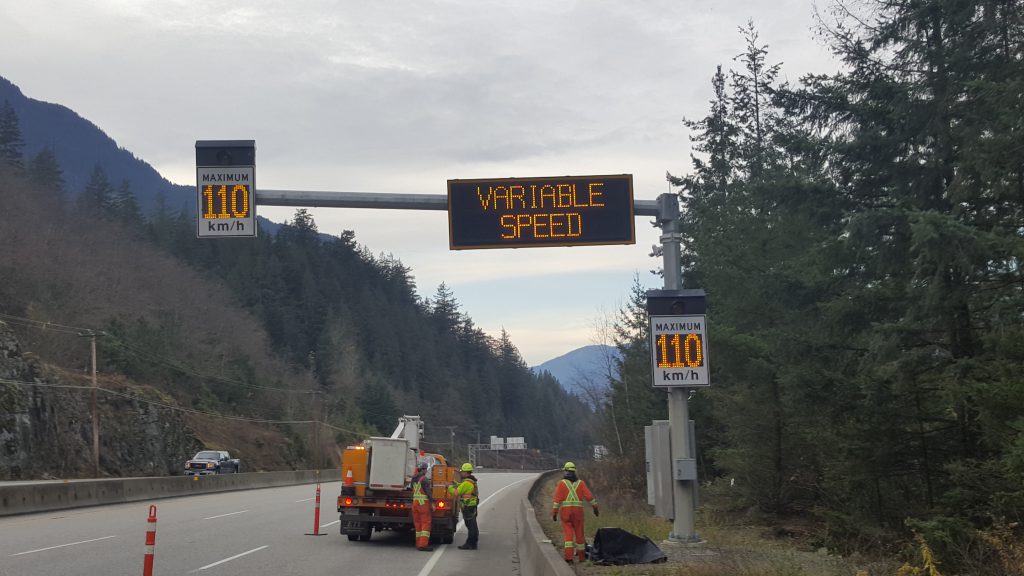
A posted speed limit is not a guarantee that it is safe to drive at that speed. Road, traffic, visibility and weather conditions can all require drivers to slow down, sometimes well below the posted limit.
Section 144(1)(c) of British Columbia’s Motor Vehicle Act prohibits driving at a speed that is excessive relative to the road, traffic, visibility or weather conditions. This means that driving at the posted speed limit can still be an offence if the circumstances make that speed unsafe.
Road conditions matter. A sharp curve, steep hill, narrow roadway, loose gravel or uneven surface may require a lower speed. Approaching a curve too quickly can leave a driver unable to maintain control, even when the road is dry and the posted limit has not been exceeded.
Traffic conditions matter, too. Heavy traffic, congestion, stopped vehicles or activity near the roadside can reduce the time and space available to react to a developing hazard. Drivers need to adjust their speed to the traffic around them and leave enough following distance to stop safely.
Visibility affects safe speed. Fog, heavy rain, snow, darkness, glare and spray from other vehicles can limit how far ahead a driver can see. A driver must be able to respond to hazards within the distance that is visible. If headlights reveal only a short stretch of road, travelling at the posted limit may leave insufficient time to stop for an obstacle.
Weather can make a familiar road unpredictable. Rain can reduce traction, while snow and ice can make braking and steering difficult. Conditions may change quickly, particularly on shaded roads, bridges and elevated sections. Drivers should reduce speed before reaching trouble spots rather than waiting until they begin to lose control.
Remember that stopping distance includes both the distance travelled while a driver recognizes a hazard and reacts, and the distance the vehicle travels after braking begins. Higher speeds increase the distance travelled during reaction time and generally increase braking distance. Poor traction can make stopping take considerably longer.
The safest speed is one that allows the driver to maintain control, see and respond to hazards, and stop within the available distance. Slow down early, increase following distance and avoid sudden braking or steering on slippery surfaces. If conditions become too hazardous to continue safely, find a suitable place to stop.
Sharing the Road With Slower Drivers
Not every driver will travel at the same speed. Someone driving below the posted limit may be responding to poor conditions, an unfamiliar road, a vehicle limitation or another legitimate concern.
Section 145(1) of the Motor Vehicle Act prohibits driving so slowly that it impedes the normal and reasonable movement of traffic, except when the reduced speed is necessary for safe operation or required by law.
Drivers who find themselves behind a slower vehicle should be patient. Tailgating, flashing headlights, sounding the horn unnecessarily or attempting an unsafe pass increases risk without making the road safer. Maintain a safe following distance and pass only when it is lawful and there is enough clear road to complete the manoeuvre safely.
Drivers travelling slowly should remain aware of traffic behind them and, where practical, allow others to pass safely. They should not, however, feel pressured to drive faster than conditions permit.
The important point is simple: the posted speed limit is a maximum, not a target that must be reached regardless of circumstances. Safe driving means choosing a speed that suits the road, traffic, visibility and weather—and showing patience toward other road users.
Canonical URL: https://www.drivesmartbc.ca/collisions/driving-too-fast-weather-conditions
--
Tim Schewe
Road Safety Advocate
DriveSmartBC.ca