
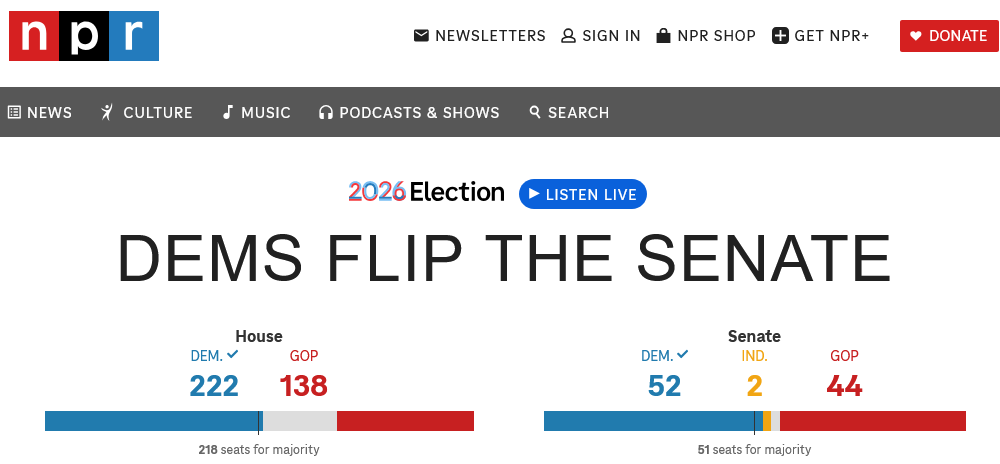
Detroit/Washington (with files from MSN/Kelly Geraldine Malone The Canadian Press/NPR) – The world woke up on Wednesday morning to control of the U.S. Congress shifting to Democrats in a clear rejection of President Donald Trump’s turbulent second term.
In a clear rebuke of the second Trump administration, Democrats flipped long held Republican Senate seats in Texas, Maine and South Carolina. A blue wave also washed over House seats and down-ballot votes in an unprecedented Democratic tsunami set to send shock waves through the Republican party.
Polling showed that Americans were frustrated with the president and his policies. Trump’s approval was plummeting due to rising gas and diesel prices, high inflation and the unpopular war with Iran.
Many Americans have shown anger regarding Trump’s policies, which have driven up costs at gas stations and grocery stores.
The trade war with Canada became a ballot box issue in close contests in Maine and Michigan.
Michigan Democrat Abdul El-Sayed — a constant target of Trump and the Republicans — beat out GOP candidate Mike Rogers while Democrat Troy Jackson ended the nearly 30-year run of Republican Susan Collins in Maine.
Trump’s attacks on Canada were so unpopular in Michigan that it forced Rogers to distance himself from Trump over the duties. El-Sayed has long called the trade war nonsensical.
Republicans and Democrats casting votes in Michigan on Tuesday said they wanted to see the trade war end. Mark Pospisil, 43, said it’s not good for Canada or the United States to have trade tensions.
“We should be friendly with our neighbours,” Pospisil said after voting for Republicans in White Lake, Mich.
The Michigan race was contentious and achieved national attention from Trump and Republicans, who made derogatory comments about El-Sayed linked to his religion and heritage.
In a speech after his win was announced, El-Sayed called out Trump and members of his administration for repeatedly mispronouncing his name.
“So after JD (Vance) swears me in in January, you can just go on and call me senator,” El-Sayed said to applause.
In Maine, the president had tried to give Collins a boost in the tough contest by making changes to 50 per cent tariffs on a range of Canadian goods to offer a reprieve to industries hit hard in Maine. The move was not enough to stop the blue wave from sweeping the state in response to high energy prices and a plummet in Canadian tourism.
Voters in some of the most Republican-safe areas showed their frustration with the president and the GOP. In Texas, James Talarico broke a decades-long Democrat losing streak by trouncing Trump-aligned Ken Paxton.
This report by The Canadian Press was first published Nov. 4, 2026.
From NPR:
From MSN/MS Now:
History makers of the 2026 midterms
The 2026 midterm results brought historic firsts for elected officials:
- Chris Pappas (D), New Hampshire: First openly gay man elected to the U.S. Senate
- Byron Donalds (R), Florida: First elected Black Republican governor
- Keisha Lance Bottoms (D), Georgia: First Black female governor
- Deb Haaland (D), New Mexico: First Native American female governor
- Peggy Flanagan (D), Minnesota: First Native American woman elected to the U.S. Senate
- Abdul El-Sayed (D), Michigan: First Muslim American U.S. senator
- Juliana Stratton (D), Illinois: Her election, alongside incumbent Sen. Tammy Duckworth (D), makes Illinois the first state to be represented by two female senators of color.
- Josh Turek (D) , Iowa: First former Paralympian elected to the U.S. Senate
Democrats win all of Texas’ statewide offices for the first time since 1961
Texas Republicans and Democrats alike are facing a political reckoning.
Democrats won five of the state’s most powerful elected offices for the first time since 1961, according to the Texas Tribune, marking a stunning reversal in a state Republicans have dominated for decades.
Democrats will win at least 250 House seats, MS NOW projects
MS NOW now estimates that Democrats will win at least 250 House seats, and Republicans will secure at least 160 seats, once all races are called. Democrats are projected to win control of the chamber.
A party needs 218 seats for a majority.
Before Election Day, Republicans held 218 seats in the House, compared with 214 for Democrats, with one independent and two vacancies.
Abortion rights won in 3 out of 4 state ballot measures
Voters backed abortion rights in three of the four states with ballot measures, according to the Associated Press.
In Virginia and Nevada, more than 60% of voters in each state backed constitutional amendments protecting abortion rights. Virginia’s amendment allows restrictions in the third trimester, while Nevada’s allows restrictions after fetal viability. Both include medical exceptions.
In Missouri, more than 55% of voters opposed reinstating an abortion ban that voters struck down through a ballot measure in 2024. The latest Missouri effort marked the first attempt to reverse abortion rights that voters previously approved.
The only state where voters rejected an abortion rights measure was in Idaho, where a measure proposed amending the state law — which currently bans almost all abortions — to establish a right to abortion up to fetal viability, with exceptions after that for medical emergencies. With approximately 91% of votes counted, 56% of Idahoans opposed the measure.
Idaho was also the only one of the four states where opponents of abortion rights outraised supporters. With the help of a $1 million donation from the Church of Jesus Christ of Latter-day Saints, anti-abortion groups raised $5.6 million compared with the $4.9 million raised by supporters of the measure, according to MS NOW’s review of campaign finance data.