Victoria – Dr. Bonnie Henry, BC provincial health officer, has issued the following statement acknowledging the fifth anniversary of the 2021 heat dome:
“As we experience the first heat of this summer, we are reminded of the tragic event in 2021 when more than 600 people in our communities died as a result of unprecedented extreme heat. While this was the first provincewide heat dome experienced in B.C., we know it will not be the last. Compounding the tragedy, most of the people who died were in their own homes, often alone, and without adequate means to cool their home.
“We know this event had a tremendous effect on families and communities who lost loved ones and also on the many first responders and health-care workers who did their utmost to care for the overwhelming number of people who were affected by the heat. On this anniversary, my thoughts are with those who were affected and those who live with trauma from that event.
“In 2021, we made a commitment to learn as much as we could about who and how people were affected, and to develop short- and long-term plans to prepare for future heat events and protect those who are most susceptible. I am particularly proud of the work of the Ministry of Health and the BC Centre for Disease Control in pulling partners together from throughout the province to form the BC Health Effects of Anomalous Temperatures (BC HEAT) committee. Together, this committee launched the BC Heat Alert and Response System (BC HARS) and the Extreme Heat Preparedness Guide. These resources help people at every level, from personal to community to provincial, to be aware and to plan for heat events.
“Heat events do not impact everyone equally. People living in poverty, individuals with mental illness and those with chronic health conditions often face higher risks when they lack access to a cool indoor space. For people who are susceptible to heat, sustained indoor temperatures over 26 C can pose a risk to health, and sustained temperatures over 31 C can be dangerous.
“We can all play a role in keep each other safe and checking in with family, friends, and neighbours who are at higher risk.
“As we head into another summer with predictions of more days and nights with high temperatures, we remind you to prepare for heat and build a plan to take care of yourself and the people around you.”
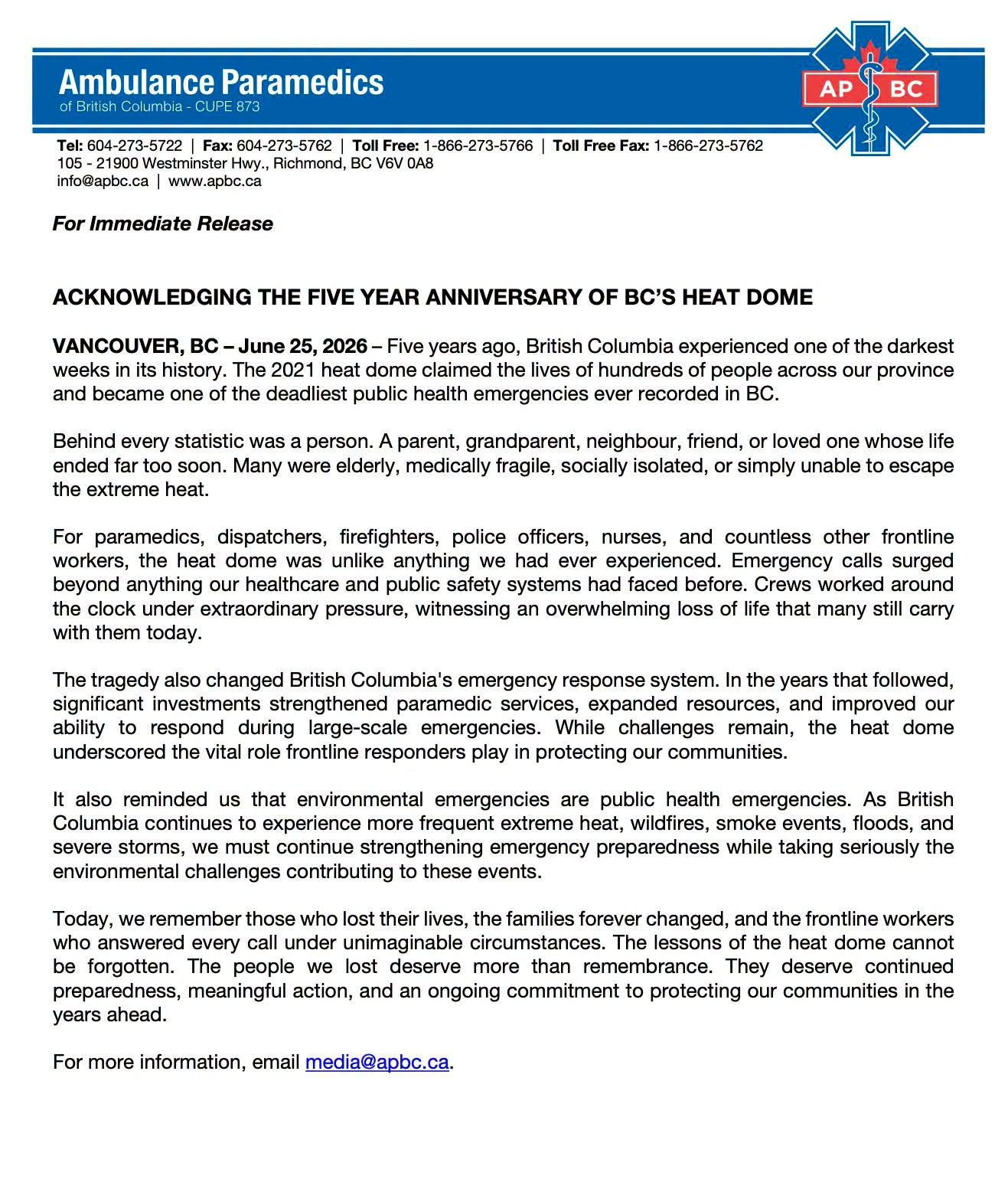
From Ambulance Paramedics Of BC: This week, we pause to remember the hundreds of British Columbians who lost their lives during the devastating 2021 Heat Dome, and to acknowledge the families, friends, and communities who continue to carry that loss. We also recognize the paramedics, dispatchers and other first responders who worked tirelessly under extraordinary conditions, witnessing the human toll of an unprecedented public health emergency. Five years later, the Heat Dome remains a powerful reminder that climate-related events are not just environmental challenges—they are public health and public safety emergencies. As we remember those we lost, we must continue working toward stronger preparedness, more resilient communities, and meaningful action to address the growing impacts of climate change.
Learn More:
- To read the BC Provincial Heat Alert and Response System (BC HARS), visit:
https://www.bccdc.ca/resource-gallery/Documents/Guidelines%20and%20Forms/Guidelines%20and%20Manuals/Health-Environment/Provincial-Heat-Alerting-Response-System.pdf - For more information about the HARS zone and historic daytime and overnight temperatures where you live, visit: https://reporting.bccdc.ca/BC_HARS_lookup/
- To learn how to prepare for heat events, visit:
https://www.bccdc.ca/health-info/prevention-public-health/preparing-for-heat-events (https) - To read the PreparedBC Extreme Heat Preparedness Guide, visit:
https://www2.gov.bc.ca/gov/content/safety/emergency-management/preparedbc/know-your-hazards/severe-weather/extreme-heat - For a list of hot weather resources throughout the Province, including cooling centres, visit: www.EmergencyMapBC.ca
- To readExtreme Heat and Human Mortality: A Review of Heat-Related Deaths in B.C. in Summer 2021, prepared by the BC Coroners Service, visit:
https://www2.gov.bc.ca/assets/gov/birth-adoption-death-marriage-and-divorce/deaths/coroners-service/death-review-panel/extreme_heat_death_review_panel_report.pdf
Two backgrounders follow.
Backgrounders
Tips for preparing for hot weather
Prepare your home for heat:
- If you have an air conditioner, fan or heat pump, make sure it is working.
- Identify a cooler space in your home and set it up so you can stay there at night, if possible. You may need to change daily living arrangements.
- Find an air-conditioned spot close by your home where you can cool off on very hot days. Consider staying with friends or family who have air-conditioned living spaces.
- Seek out places in your community that have climate-controlled environments, such as movie theatres, libraries, community centres and shopping malls.
- Install awnings, shutters, blinds or curtains over windows to keep the sun out during the day.
- Get a digital room thermometer to keep with you so you know when your home is getting too hot.
Take care of each other during heat events:
- Checking on your friends and family, and creating a plan for supporting each other during heat events can help keep everyone safer.
- Think of people you know who may be more susceptible to heat and develop a buddy system. The following groups are more susceptible to heat-related illness if they do not have access to a cool space in their homes. Older adults, especially those living alone, are at elevated risk across most of these categories:
- people with severe mental illnesses (e.g., schizophrenia) or cognitive impairments (e.g., dementia) that may affect their mental capacity to respond to the heat
- people with multiple chronic conditions or disabilities that may affect their physical capacity to respond to the heat
- people with chronic conditions such as respiratory disease, heart disease, neurological disease or diabetes
- people with substance-use disorders
- people who are living in poverty, marginally housed or experiencing homelessness
- pregnant people
- infants and young children
- People working or exercising in hot environments are also at higher risk.
- Make a plan to check in with your hot weather buddy often, especially in the evening when indoor temperatures are highest. It is also good to plan a check-in for early morning, to see how your buddy has managed through the night.
- If your home is cooler, invite those who are at highest risk to stay with you during heat events, if possible.
Investments by the Province in preparing for heat events
In 2023, the Province, in partnership with BC Hydro, provided free, publicly funded portable air conditioners (AC) to those most susceptible to heat. That program resulted in 27,382 AC units purchased and installed in homes.
The Province updated the BC Building Code to make new buildings safer and more accessible for people, and more resilient to climate change. As of March 8, 2024, all new homes in B.C. are required to provide one living space in each dwelling unit that is designed not to exceed 26 C through either passive measures (e.g., shading) or mechanical cooling (e.g., air conditioning).
The Province has made historic investments to help communities reduce risks from future disasters due to natural hazards and climate-related risks.
Since 2017, nearly $350 million has been provided to First Nations and local governments through the Community Emergency Preparedness Fund. Since its launch in 2024, the Disaster Resilience and Innovation Funding program has provided approximately $45 million to support disaster risk reduction and climate adaptation projects. The Community Emergency Preparedness Fund and the Disaster Resilience and Innovation Funding program support projects to help communities prepare for and mitigate natural hazards and climate-related hazards, including extreme temperatures.
In 2022, the Province introduced the ability to issue a BC Emergency Alert for extreme heat emergencies. In the event of an extreme heat emergency, the Ministry of Emergency Management and Climate Readiness works proactively with local governments and First Nations by providing guidance on heat-related risks and reimbursing eligible expenses to open emergency cooling centres.