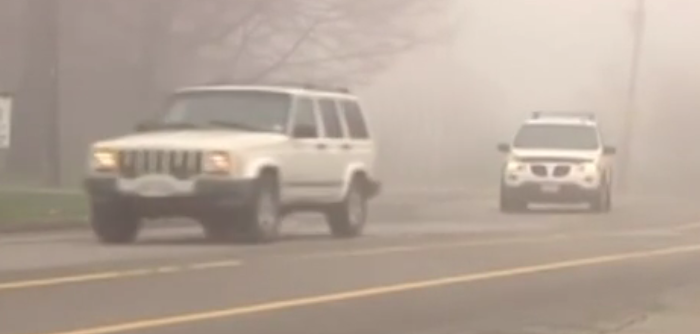
Fog can turn an ordinary drive into a very different experience in just a few seconds. The road may be wet, visibility may be measured in hundreds rather than thousands of metres, and vehicles travelling toward you or in front of you can seem to appear out of nowhere.
The most important thing to remember is simple: you have to drive at a speed that allows you to stop within the distance you can see is clear.
I once received an account from a driver travelling south on the Inland Island Highway through heavy fog. Visibility was estimated at about 200 metres, and the driver reduced speed to about 80 km/h, slowing further when necessary. Other vehicles were passing at speeds the driver estimated at 130 km/h or more.
The important question isn’t whether another driver appears comfortable travelling faster than you. The question is whether you can see far enough ahead to stop if something unexpected is in your path.
Fog reduces the information available to you. Speed reduces the amount of time you have to interpret that information and respond to it. That’s why reducing speed and increasing following distance are so important. Don’t let yourself gradually speed back up simply because you have become accustomed to the fog.
Don’t drive faster than you can see
Your headlights don’t give you permission to travel at the posted speed limit. They give you some information about what lies ahead.
If you cannot see far enough ahead to stop safely, you’re travelling too fast for the conditions.
The same principle applies in darkness, heavy rain, snow, around a curve or over a hill. A posted speed limit is the maximum permitted speed under the circumstances in which it applies. It is not a guarantee that the speed is safe for every condition.
Following too closely is dangerous in good weather. In fog, it leaves even less room for error. Increase the distance between your vehicle and the one ahead. Don’t use that vehicle as a substitute for seeing the road yourself.
Passing is also a poor choice when you cannot see far enough ahead to know what is coming.
Use your lights properly
Your vehicle needs to be visible to other road users as well as allowing you to see. Make sure your windshield, headlights and other lamps are clean. Use the lighting appropriate for the conditions and know how your vehicle’s lighting controls work. Don’t assume that the automatic setting will always provide the lighting you expect in fog or other reduced-visibility conditions.
Fog lamps can be useful in genuinely poor visibility, but they aren’t a substitute for sensible speed and careful observation. Front fog lamps are designed to illuminate the road immediately ahead and to the sides of the vehicle; they are not intended to let you drive faster by extending your seeing distance.
Rear fog lamps have a different purpose. They make your vehicle more visible to following drivers when visibility is seriously reduced. They should not be used simply because it is raining, snowing or dark, because their intense red light can cause glare and make it more difficult for other drivers to distinguish your brake lights.
Keep looking
Fog can make it tempting to stare directly at the road immediately ahead. Instead, keep your eyes moving. Search for changes in the road, lane markings, lights, signs and other road users. Maintain your lane position and use the roadway markings that remain visible to help guide you.
Clean glass makes a difference too. Moisture, dirt and glare on the windshield can make already poor visibility worse.
Sometimes the best decision is not to go
If visibility is poor before you leave, ask yourself whether the trip really needs to be made now. If the answer is no, postponing the trip may be the safest option.
If you’re already on the road and conditions deteriorate, consider whether there is a safer route or a suitable place where you can get completely off the roadway and wait for visibility to improve.
Fog doesn’t change the rules of physics. When visibility is reduced, slow down, increase your following distance and make sure you can stop within the distance you can see is clear.
Getting there a few minutes later is a much better outcome than discovering that the road ahead has stopped being visible before your vehicle has stopped moving.
Canonical URL: https://www.drivesmartbc.ca/miscellaneous/driving-safely-fog
NOTE: This is a rewrite of an article from 2017
--
Tim Schewe
Road Safety Advocate
DriveSmartBC.ca