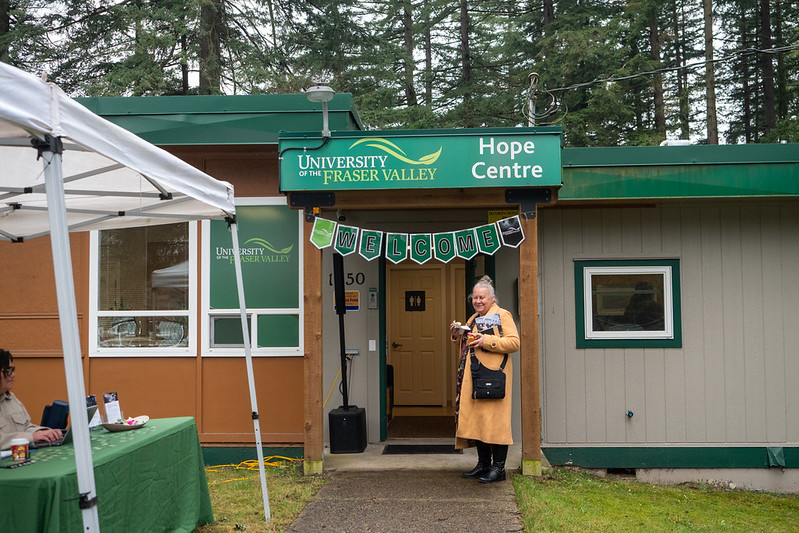

Hope (UFV Communications) – For nearly two years during and after the pandemic, the halls of the University of the Fraser Valley’s Hope Centre sat quiet.
Now, guided by extensive community feedback, the centre is rebuilding its role as an education hub for the eastern Fraser Valley.
Through interviews and surveys with partners including the District of Hope, School District 78 Fraser-Cascade, Indigenous organizations and regional service groups, a comprehensive Community Needs Assessment report has helped chart the path forward for the long-standing centre.
The Hope Centre has been part of UFV since the beginning, opening its doors on Oct. 1, 1974. Coordinator Crystal Sylvester said the COVID-19 pandemic and staff changes hit the centre hard, leaving it quiet for nearly two years.
“The Hope Centre’s superpower has always been its connection to community,” she said. “That lack of presence was really felt.”
Sylvester’s arrival as coordinator in January 2025 fulfilled one of the wishes identified in the report, re-establishing a human presence at the location.
Restoring in-person classes was another priority. After significant renovations to modernize the building on 7th Avenue, the Hope Centre returned to in-person learning last September, launching its first bookkeeping course with support from a StrongerBC future skills grant.
With an older, diverse population, the Hope region has a strong demand for computer and health-care training.
The assessment also found growing interest in English-language learning. With many newcomers to Canada settling in the region, community members expressed strong interest in English for Academic Purposes (EAP), which prepares learners whose first language is not English for study or research at universities and colleges. The Hope Centre now offers EAP through funding from an English Language Learning pathway grant.
Additional programming is also being explored, including dual-credit trades opportunities and UFV’s Building Service Worker program.
Planning is also underway for first aid and FoodSafe training — courses with high relevance in a community that sees a surge in tourism during the summer months.
Indigenous partners identified a need for upgrading and short certificate programs that allow mature learners to build confidence and succeed in education within their own communities.
The Hope Centre serves a large geographic area, stretching as far as Princeton and Boston Bar. The region is underserved by transit, making it difficult for some students to attend classes in person. Another access barrier is the notoriously sporadic Internet access in the Hope community.
One solution was the installation of a HyFlex system last summer, allowing learners to connect with classes across UFV campuses and enabling hybrid or online course delivery.
“It’s not simply about holding in-person classes, but also about how we can project out and become an education hub,” Sylvester said. “Our building is now capable of serving as a flexible space for workshops, training, and community events, both for UFV and the broader community.”
Sylvester said the region has strong energy for collaboration among local organizations and committees, and she hopes UFV will continue to play a central role.
“They are excited to have UFV in the community, and working with all of these groups and individuals has been my favourite part of this process,” she said.
“When I started one year ago, there were a lot of feet on the ground gathering data, conducting interviews and talking to people. It was the perfect way to dive in.”
The Hope Centre operates under UFV’s School of Continuing Education, led by director Carolyn MacLaren.
MacLaren said the assessment is only the beginning of the centre’s renewed engagement with the community.
“Although this initial assessment may be complete, the work is only beginning,” she said. “We remain committed to listening to the Hope community’s needs to ensure UFV’s presence continues to engage learners, transform lives and build community in the eastern Fraser Valley.”
As Sylvester looks to the future, she sees opportunities to expand programming further.
“I’d like to see us launching more of our Continuing Education programs in Hope so students can walk away with certifications,” she said. “I’d also love to connect with current or retired faculty who live in Hope and may be interested in teaching or contributing to the Hope Centre, and to have more UFV faculty visit for presentations.”